
247 views
Understanding your legal rights when dealing with law enforcement is essential. Whether you are stopped on the street, taken into custody, or have your home searched, knowing what to do can protect you.
1. When the police stops you
- If the police is not in uniform, ask the police to show his/her authority card
| Colours | Meaning |
| Red | Suspended police officer. He/she has no authority to do anything to you. Walk away. |
| Blue | Rank of Inspector and above |
| Yellow | Below the rank of Inspector |
| White | Reserve police |
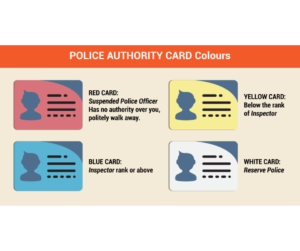
Note the police’s name and ID number on his/her authority card.
- If police in uniform: note his/her name and ID number on his/her uniform
Police vehicle: note the number plate of the police patrol car or motorcycle.
2. When the police questions you
Only give your name, NRIC number and address
Politely ask “Am I under arrest?”
If you are not under arrest, you may walk away or refuse to follow him/her back to the police station or anywhere else, if asked to.
You are arrested if the police: Answer yes or does not allow you to leave/ wants to take you to the police station or handcuffs you
3. When the police arrests you
Ask the reason for the arrest. An arrest is unlawful if you are not informed of the reason.
Do not resist an arrest.
Your Rights on Arrest
Get legal advice ASAP – The law around drugs and arrest is complex, so always ask for a solicitor.
You have the right to be treated fairly by the police.
You do not have to answer questions – but be aware that if you later rely on something in court that you did not mention when questioned, the court may take a negative view of this.
Police interviews can be intimidating – do not feel pressured to speak without legal representation.
Even if you are innocent, do not assume the police will let you go quickly—insist on legal advice before answering questions.
Remember:
✔ If you give an innocent explanation early, the police may drop the case.
✔ However, it is wise NOT to discuss your case until you have seen a solicitor.
✔ “Friendly chats” with police are NOT informal – anything you say can be used against you.
✔ If the police act unfairly, take note of officers’ details and seek legal advice later.
4. Body search
If you are at a place (example: club / karaoke / entertainment outlet) where the police are conducting a raid to look for something there (example: dangerous drugs), the police may detain and search your body / bag without arresting you.
-
- This may only be done in the presence of a police officer ranked Inspector and above.
- What to do?
- Do not allow the police officer to put his/her hands into your pocket / clothes or bag.
- Clear your pocket / bag in front of the police officer voluntarily so that you can monitor your belongings. Take out your belongings one by one, and state each of the items you are taking out, example “purse”, “keys”, “IC”, etc.
- When your pockets / bags are empty, turn your pockets / bags inside out.
Your rights
- A female can only be body searched by a female police officer.
- All body searches must be carried out in a professional manner and with decency (example: A search cannot be done on areas of your private parts).
- There are no laws that compel one to strip naked (even upon arrest)
Bookmark this site, and we’ll come back to it in Part 2.